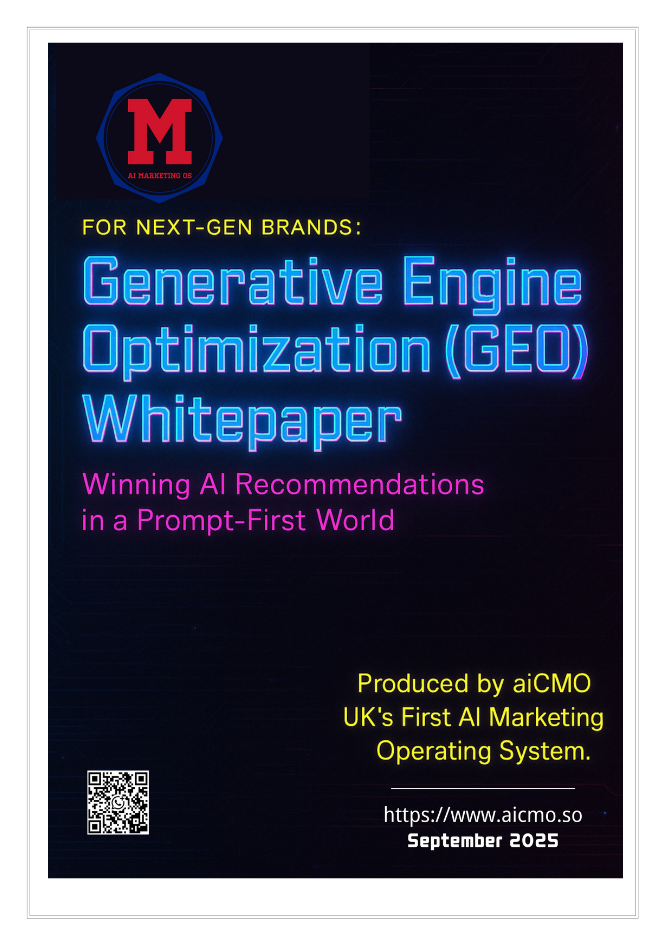
Cover of AI marketing OS: Generative Engine Optimization (GEO) for Next-Gen Brands

AI Marketing OS: Generative Engine Optimization (GEO) Whitepaper for Next-Gen Brands

Discover how Generative Engine Optimization (GEO) is revolutionizing brand growth. Learn how AI-driven content creation, SEO strategies, and marketing automation can help your brand scale faster and more efficiently than ever before.

This comprehensive whitepaper explores the transformative power of GEO and provides actionable insights for brands looking to leverage AI for scalable growth. Whether you're a startup or an established business, understanding and implementing GEO strategies can give you a competitive edge in today's digital landscape.

Frequently Asked Questions

GEO is the practice of optimising your content so it can be understood, trusted, and cited by AI systems. It goes beyond SEO, focusing on how AI interprets and recommends information.

As AI becomes the new gatekeeper of information, GEO ensures your brand is visible in AI-driven answers. Without it, even top-ranked websites risk being invisible in AI search results.

SEO focuses on ranking in search engines. GEO focuses on being cited and recommended by AI systems like ChatGPT, Gemini, or Copilot. GEO includes retrievability, trust signals, and extractability.

It refers to a world where users increasingly ask AI assistants for answers instead of using search engines. Visibility depends on being recommended directly in AI responses.

The GEO Triple Standard means your content must be retrievable, extractable, and trustworthy for AI systems. Together, these ensure your brand gets surfaced in AI answers.

Retrievability ensures your content is technically accessible to AI systems through proper structure, schema markup, and machine-readable formats.

Extractability means your content is structured so AI can easily quote, summarise, or reuse it — for example through FAQs, tables, and clear headings.

Trust means your content is factually reliable, properly attributed, and supported by schema markup. AI systems prefer content they can verify.

Schema.org provides structured data markup that helps AI interpret your brand, articles, products, and FAQs without ambiguity, boosting trust and visibility.

Organization Schema declares your official brand name, logo, and profiles. It gives AI a clear digital identity for your brand.

FAQPage Schema encodes common questions and answers directly into your page, making it easy for AI to quote you verbatim in responses.

How-To Schemas break down instructions into clear steps, which AI can easily parse and present for practical queries.

It ensures AI correctly identifies your brand in its knowledge graphs. For example, distinguishing 'Apex Software' from 'Apex Construction.'

Concise, fact-rich content with dates, stats, and definitions makes your pages quotable and trustworthy for AI.

These are centralised, authoritative sources of truth that AI systems use to verify facts about your brand. They act as a 'verifiable fortress of facts.'

Zero-click means users get their answers directly from AI responses without visiting your site. GEO ensures your brand is still visible and credited.

It’s a framework to measure how well your brand is performing in GEO, including readiness, authority, and AI citation rates.

It’s the process of tracking when and how AI systems mention or use your brand’s content, helping you measure visibility and correct misinformation.

It measures how often your brand is cited by AI compared to competitors, showing your visibility in AI answers.

Snippet ownership means your brand controls the quoted answer that AI systems use for a specific query.

Without GEO, your brand can be filtered out by AI before a user even performs a traditional search, making you invisible in discovery.

Any industry with digital presence — SaaS, eCommerce, local services, media, education — can benefit, as all rely on AI-driven discovery.

GEO involves aligning your content to the natural language prompts users type into AI systems, ensuring you show up in those conversations.

It’s the blending of information retrieval, UX, content strategy, and PR to ensure your brand systematically appears in AI search results.

Automation bias is when users over-trust AI answers. GEO ensures your brand provides accurate, reliable content to avoid misinformation.

It means structuring content to lead with the direct answer to a query, followed by supporting evidence. This makes it quotable for AI.

Persona design creates rich brand personas that AI can understand and simulate, shaping how your brand appears in AI-driven conversations.

It’s content that provides clear comparisons, decision trees, or guidance paths to help AI agents guide users effectively.

They are small, standalone, fact-rich content pieces that AI can easily retrieve and quote without misinterpretation.

It’s the process of building trust and authority with AI over time by consistently demonstrating expertise and reliability.

Provenance tracks who wrote content, when it was updated, and whether it’s official. AI uses this to assess accuracy and freshness.

It’s when users make purchase decisions directly inside AI conversations, bypassing websites. GEO positions your brand inside those journeys.

GEO supports Expertise, Authoritativeness, and Trustworthiness by structuring content for credibility, citations, and machine readability.

Instead of clicks, brands should measure AI citation share, snippet ownership, post-view actions, and win rate in AI answers.

It measures how often your content is chosen by AI to respond to target prompts, a new core GEO metric.

It tracks the business impact of AI-driven visibility — such as conversions from AI mentions — beyond website traffic.

Prompt templating builds a library of effective queries and answers, ensuring your brand consistently performs in AI discovery.

AI marketing operating systems automate the entire GEO workflow, from keyword research to publishing and monitoring citations.

Images, videos, and audio must be made machine-readable with transcripts, alt text, and captions so AI can index them.

It’s a rigorously maintained hub of structured, timestamped facts that AI can trust as your definitive reference.

It’s a process for monitoring and correcting AI-generated inaccuracies about your brand quickly to maintain trust.

Atomic content breaks insights into standalone nuggets with lists, bullets, and short paragraphs, optimised for AI reuse.

Brands that ignore GEO risk losing relevance, visibility, and ultimately revenue, as AI increasingly filters user attention.

Because AI evolves rapidly, GEO must be a living strategy — constantly refined to maintain visibility and trust.

Human oversight ensures AI-generated or optimised content remains accurate, factual, and aligned with brand values.

Early adopters of GEO build a competitive moat, making it harder for latecomers to catch up in AI visibility.

AI tends to cite a few authoritative sources repeatedly. Being early and consistent in GEO secures disproportionate visibility.

It means GEO is never done — continuous adaptation, monitoring, and iteration are essential for long-term success.

GEO drives measurable ROI by boosting AI-driven traffic, citations, and post-view conversions that traditional SEO metrics miss.

As AI agents increasingly make decisions for users, GEO ensures your brand is a trusted, recommended option in those paths.

Still have a question?

Ask on Discord

or

Submit a ticket.

Launch Effortless Blogging with Maggie

No more blank pages. Maggie runs your blog with vibe-rich, SEO-tuned, GEO-smart content — built to be loved by search engines and surfaced by AI.

Contact Sales
img

Follow us


icon

All rights reserved by AI Marketing OS Ltd. Designed & Developed by TOPY.AI .