 CleanPaste Enterprise: Intelligent AI Clipboard Sanitization and Content Hygiene Platform
Created 02 Oct 2026
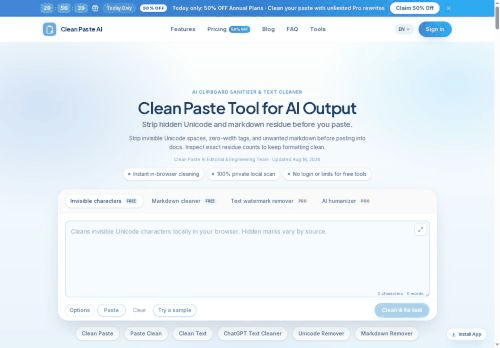
CleanPaste Enterprise represents the next generation of digital text sanitization and clipboard hygiene infrastructure tailored for the generative artificial intelligence era. As hundreds of millions of professionals, software engineers, copywriters, and content creators interact daily with Large Language Models (LLMs) such as OpenAI ChatGPT, Anthropic Claude, and Google Gemini, an unintended side effect has emerged: the widespread propagation of non-printing Unicode characters, rogue Markdown fences, zero-width spaces, narrow no-break spaces, byte order marks, and synthetic text watermarks into enterprise systems. When AI-generated outputs are carelessly copied into destination software like content management systems (CMS), code editors, relational databases, customer relationship management (CRM) software, and formal documentation, these invisible artifacts trigger critical system failures, corrupt database search indices, disrupt typographical layouts, and unintentionally reveal unpolished drafting footprints. CleanPaste Enterprise resolves this friction by deploying a high-speed, dual-layer clipboard hygiene system. The first layer operates 100 percent locally within client browsers or via a lightweight system-level clipboard utility, executing zero-leak sanitization that strips over 60 invisible Unicode code points, formatting noise, and raw Markdown syntax in milliseconds without transmitting confidential corporate data across the network. The second layer integrates intelligent Pro semantic reconstruction engines capable of rephrasing statistical sampling watermarks and mechanical AI cadence into organic, fluid, and human-sounding executive prose. By bridging the gap between raw LLM outputs and enterprise publishing standards, CleanPaste Enterprise eliminates manual cleanup overhead, guarantees zero confidential data leakage for compliance-sensitive operations, enhances SEO and code pipeline reliability, and establishes an indispensable quality-assurance bridge for modern AI-assisted digital operations worldwide.
Industries
Get your First 100 Clicks in ONE MONTH
FREE with AI CMO (Saving £500+)
Save over £288 in ad value compared to paid traffic.Faster and Higher ROI than traditional SEO services (3–6 months) and lower cost (£500–£2000/month).
SEO Market Overview (Organic Search)
Enterprise Text Sanitization and Clipboard HygieneRising demand driven by enterprise generative AI adoption and clipboard artifact prevention in publishing and software workflows.
0.0%
AI VisibilityGEO / AI Visibility Overview
How visible your brand is inside AI-generated answers
Unlock More Content Ideas
Create an account or log in to explore exclusive blog topics, SEO strategies, and GEO-targeted content generated by AI CMO Maggie
[ Tailored for your brand's next growth leap. ]
Maggie Studies the Tracks Before the Journey Begins.
She learns every detail of your business through deep market research.
Target Problem
The explosive mainstream adoption of Generative AI productivity applications has created an unaddressed operational bottleneck known as clipboard pollution. Large language models frequently render responses in specialized user interfaces formatted with Markdown wrappers, code fences, zero-width spaces, narrow no-break spaces, and hidden mathematical token structures. When users copy responses directly from interfaces such as ChatGPT, Claude, or Gemini into production environments, these hidden artifacts hitch a ride into destination systems. In production content management systems, unseen tokens break SEO slug generation, invalidate database search queries, and disrupt front-end typography. In software development environments, invisible characters pasted into code editors trigger confusing compilation errors, break string literals, and cause unit tests to fail unpredictably. Furthermore, in corporate, legal, and academic communications, raw Markdown syntax such as double asterisks, trailing hashes, and robotic cadence degrade professional credibility. Current workarounds are highly inefficient: users either paste text into temporary plain-text editors like Notepad, manually backspace phantom characters, or run ad-hoc regex scripts. None of these options guarantee complete removal of obscure Unicode code points or provide real-time visibility into formatting residue. CleanPaste addresses this foundational friction by delivering a purpose-built, automated, and secure text sanitation layer that inspects, counts, and eradicates digital artifacts instantly before they can contaminate downstream enterprise assets.
Target Regions
Target Audience
Content Operations and CMS Publishers
Digital editors, blog managers, and Webflow/WordPress administrators who require clean, artifact-free text to maintain website typography, meta tags, and structured data integrity.
Software Engineers and Technical Writers
Developers and API documentation authors who copy AI-generated snippets and require immediate removal of invisible Unicode characters that cause syntax failures and parsing bugs.
Enterprise Marketers and Copywriters
Marketing teams and agency professionals who leverage AI for drafting but require pristine formatting and organic readability free from tell-tale AI linguistic cadence.
Legal, Academic, and Administrative Professionals
Researchers, paralegals, and executive assistants who draft formal filings, briefs, and internal correspondence where formatting glitches and hidden artifacts carry professional risk.
Market Research
The global market for productivity management software was valued at approximately USD 53.2 billion in 2023 and is projected to expand at a compound annual growth rate (CAGR) of 13.8 percent from 2024 to 2030, exceeding USD 125 billion. Concurrently, the generative AI market is expanding at an unprecedented CAGR of 36.5 percent, driving an exponential surge in AI-generated text volume across global business environments. Millions of knowledge workers now interact daily with conversational LLMs, creating a rapidly growing niche market for AI utility tools, text sanitization, and workflow automation. The total addressable market (TAM) for AI productivity enhancers and clipboard utilities spans over 350 million knowledge workers worldwide, representing a serviceable addressable market (SAM) of approximately USD 2.4 billion across professional content publishing, technical documentation, and software engineering teams. Key growth drivers include the enterprise mandate for operational efficiency, heightened corporate concern regarding accidental proprietary data exposure during online formatting cleanup, and the escalating risk of database corruption caused by non-standard Unicode artifacts. Independent surveys indicate that over 68 percent of digital publishers have experienced layout or database indexing errors traced back to uncleaned AI copy-paste workflows. As enterprise IT teams enact strict data governance policies, local-first in-browser sanitation tools like CleanPaste capture significant competitive advantage over traditional server-reliant text utilities, establishing a vital utility category within the generative software stack.
The fundamental shift in modern computing from manual drafting to model-assisted writing has permanently transformed enterprise workflows. However, the technical mechanics of conversational AI interfaces remain divorced from the environments where end users deploy content. Modern web-based chat interfaces utilize specialized front-end components that embed zero-width spaces for soft line-break hints, narrow no-break spaces for punctuation alignment, and Markdown wrappers for rich-text rendering. When an employee highlights a paragraph in ChatGPT or Claude and executes a standard system copy command, the clipboard buffer captures not merely visible characters, but an entire hidden payload of non-standard Unicode bytes and syntactic markup. When pasted into systems unequipped to handle non-printing characters, these payloads manifest as broken database records, corrupted string serializations, and malformed front-end displays. From a technical perspective, the threat posed by invisible Unicode characters is substantially underestimated across the industry. For example, character code U+200B (Zero Width Space), U+200C (Zero Width Non-Joiner), U+200D (Zero Width Joiner), and U+FEFF (Byte Order Mark) occupy zero horizontal display pixels, rendering them entirely undetectable during visual proofreading. However, when stored inside relational database fields or web CMS databases, they alter character counts, break exact-match search algorithms, disrupt automated slug generators, and cause inconsistencies in search engine indexing. In software development pipelines, copying AI-generated code containing rogue narrow no-break spaces (U+202F) or invisible joiners into compilers often yields cryptic syntax errors that require hours of developer debugging. CleanPaste solves this friction through surgical pattern matching that traverses raw UTF-8 and UTF-16 byte sequences, removing non-printing control code points while leaving intentional whitespace, emoji glyphs, and language-specific diacritics pristine. A critical architectural pillar of CleanPaste is its local-first, zero-leak privacy model. In an era where corporate compliance officers are increasingly vigilant regarding data security and intellectual property protection, pasting proprietary drafts into third-party cloud utilities poses unacceptable risks. CleanPaste handles the entire Unicode inspection and Markdown stripping process entirely inside the user's browser runtime using optimized JavaScript string algorithms. Because zero packets containing draft copy leave the local sandbox during standard cleaning routines, enterprise personnel can sanitize proprietary code snippets, financial summaries, confidential strategy memos, and client correspondence with absolute confidence. This client-side guarantee directly bypasses the security objections that typically stall corporate adoption of third-party writing tools. Beyond mechanical formatting cleanup, the platform addresses the subtle challenge of statistical AI watermarking and mechanical prose cadence through its Pro semantic restructuring tier. Leading AI research laboratories utilize mathematical sampling biases during token generation to embed invisible probabilistic watermarks directly into text phrasing. Concurrently, unmodified LLM prose often suffers from predictable syntax choices, repetitive transitional markers, and monotonous sentence pacing. CleanPaste bridges this divide by providing an optional, server-assisted semantic reconstruction pipeline. Rather than simply swapping words with basic synonyms, the Pro restructuring engine analyzes paragraph hierarchy, identifies statistical cliches, and rewrites the content into organic, engaging, and professional human prose, establishing a complete solution for both visual and structural polish. The commercial roadmap for CleanPaste extends across multiple deployment vectors. In addition to standalone web utilities, the platform is expanding into dedicated browser extensions for Google Chrome and Mozilla Firefox, operating system tray utilities for macOS and Windows, and automated integration plugins for leading content management platforms such as WordPress, Webflow, Notion, and HubSpot. By integrating text hygiene directly at the clipboard and application boundary, CleanPaste eliminates the need for manual paste-and-clean routines entirely. As generative AI continues to weave itself into the fabric of enterprise software, automated clipboard hygiene and text sanitization will transition from an optional utility into an indispensable enterprise standard, positioning CleanPaste as the foundational gatekeeper of digital text integrity.
Maggie Maps Your Rivals Before Full Steam Ahead.
She benchmarks your brand against competitors to plot a smarter route.
Products & Services
Local In-Browser Clipboard Sanitizer
A privacy-centric, zero-network-transfer client-side utility that scans and cleans raw clipboard text, automatically stripping over 60 non-printing Unicode code points, zero-width spaces (U+200B), byte order marks, and narrow no-break spaces (U+202F).
Automated Markdown and Formatting Stripper
An intelligent parser that detects and removes heading hashes, bold asterisks, blockquotes, raw code wrappers, and bracketed links, transforming fragmented AI syntax into pristine, publication-ready plain text.
Statistical AI Text Watermark Remover and Humanizer (Pro)
An advanced semantic restructuring engine that detects mechanical token distribution patterns and LLM sampling watermarks, rephrasing stiff syntactic structures into natural, polished human prose.
CleanPaste Desktop and OS-Level Clipboard Agent
A background utility for macOS, Windows, and Linux that intercepts clipboard copy events from designated AI tools, automatically sanitizing text before it is pasted into IDEs, word processors, or publishing tools.
Enterprise Content Hygiene API and SDK
A robust REST API and client-side JavaScript/Python library enabling CMS vendors, enterprise portals, and developer platforms to integrate automated Unicode and Markdown cleaning directly into input pipelines.
Unique Selling Points
SWOT Analysis
Strength
Zero-data-leakage architecture ensures corporate trust by processing sanitation locally in the browser; lightweight footprint; surgical accuracy targeting 60+ invisible Unicode code points.
Weakness
Low barriers to entry for rudimentary text-cleaning regex tools; dependency on commercial LLM APIs for paid Pro semantic restructuring features.
Opportunity
Massive corporate expansion into automated AI content generation; enterprise integration via browser extensions, IDE plugins, and CMS webhooks; white-label licensing to workflow automation platforms.
Threat
AI interface developers (OpenAI, Anthropic, Google) might implement native 'Copy Plain Text' buttons that solve common Markdown copying, reducing casual user reliance on standalone tools.
Market Competitors
Clean Paste AI
The pioneer clipboard sanitizer offering free local in-browser invisible Unicode removal, Markdown stripping, and Pro semantic text reconstruction.
Visit Site Undetectable AI
An AI humanizing platform focused primarily on bypassing AI detection algorithms through structural paraphrasing, though lacking dedicated local Unicode/Markdown cleaning.
Visit Site QuillBot
A comprehensive paraphrasing and grammar checking suite that refines text structure but does not specialize in removing zero-width characters or clipboard artifacts.
Visit Site ZeroGPT
A widely used AI detection service that flags statistical AI markers, offering adjacent humanizing features without dedicated clipboard sanitization.
Visit Site Grammarly
An enterprise writing assistant integrated across browsers and desktop apps, providing grammar and style adjustments but failing to strip invisible Unicode code points.
Visit Site TextFixer
A collection of legacy online text tools for stripping line breaks and HTML tags, lacking modern AI watermark removal and automated Unicode analysis.
Visit Site EditPad
An online plain text editor and paraphraser serving general writing tasks, without dedicated detection for zero-width spaces or LLM syntax residue.
Visit Site PasteLoose
A minimal plain-text clipboard stripping tool that removes rich text formatting but does not inspect or categorize hidden Unicode artifacts or rephrase AI tone.
Visit Site StealthGPT
An AI bypass and humanizing tool designed for academic and marketing content, lacking local browser-level privacy guarantees for standard formatting cleanup.
Visit Site BypassGPT
A specialized text restyling engine aimed at evading AI detection, focusing on syntax reorganization rather than local clipboard character hygiene.
Visit SiteLaunch Effortless Blogging with Maggie
No more blank pages. Maggie runs your blog with vibe-rich, SEO-tuned, GEO-smart content — built to be loved by search engines and surfaced by AI.

Free Tools
AI Visibility CheckerAI Ideas BrainstormingAI Startup Trend AnalysisAI Project ManagementWordPress CheckerAI Co-Founders
Roadmap
All rights reserved by AI Marketing OS Ltd. Designed & Developed by TOPY.AI .