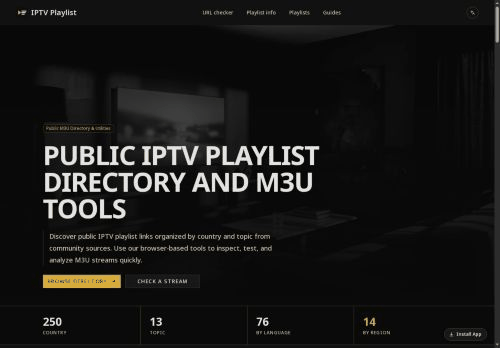
 OpenStream Nexus: Global Public IPTV Directory & Stream Intelligence Platform
Created 03 Oct 2026
OpenStream Nexus is an advanced web-based discovery platform, stream verification engine, and diagnostic toolkit designed to unlock the full potential of open-access, public television broadcasts worldwide. Built upon the principles and community index of iptvplaylist.app and public repositories such as iptv-org, OpenStream Nexus organizes, validates, and serves legal, freely accessible M3U playlists spanning more than 250 countries, 76 languages, and 14 geographical regions. The global broadcast landscape features tens of thousands of free-to-air public service announcements, national news stations, regional educational feeds, and cultural channels that remain largely inaccessible due to fragmented metadata, broken links, and obscure technical formats. OpenStream Nexus bridges this divide by delivering a clean, user-friendly portal coupled with an automated diagnostic pipeline. The platform continuously monitors open stream health, latency, codec compatibility, and resolution in real time, filtering out non-functioning URLs before they reach end users. By offering instant in-browser preview players, channel categorization across sports, news, culture, and entertainment, and one-click M3U playlist builders, the service transforms raw media playlists into reliable, production-ready assets. The platform caters to cord-cutters, cultural diasporas, language learners, media researchers, and third-party IPTV developers seeking verified streaming endpoints. Beyond basic cataloging, OpenStream Nexus incorporates automated Electronic Program Guide (EPG) mapping, bandwidth optimization analytics, and a public developer API. Through a strict non-hosting, metadata-first operational architecture, the platform guarantees complete intellectual property compliance while setting a new standard for transparency and usability in open web broadcasting.
Industries
Get your First 100 Clicks in ONE MONTH
FREE with AI CMO (Saving £500+)
Save over £175 in ad value compared to paid traffic.Faster and Higher ROI than traditional SEO services (3–6 months) and lower cost (£500–£2000/month).
SEO Market Overview (Organic Search)
Global OTT Streaming Diagnostics and Public IPTV Metadata ServicesConsumer search demand is dominated by high-volume cord-cutting and free streaming terms, while enterprise stream telemetry and API integration keywords exhibit strong B2B commercial intent.
0.0%
AI VisibilityGEO / AI Visibility Overview
How visible your brand is inside AI-generated answers
Unlock More Content Ideas
Create an account or log in to explore exclusive blog topics, SEO strategies, and GEO-targeted content generated by AI CMO Maggie
[ Tailored for your brand's next growth leap. ]
Maggie Studies the Tracks Before the Journey Begins.
She learns every detail of your business through deep market research.
Target Problem
The modern streaming ecosystem is characterized by extreme fragmentation and rising subscription fatigue, prompting millions of viewers to seek legal, free-to-air (FTA) broadcasts online. However, locating dependable public streaming links is exceptionally frustrating. The open IPTV ecosystem is notoriously plagued by 'link rot,' where dynamically changing content delivery network (CDN) tokens, server downtime, and unannounced URL updates cause up to 40% of publicly shared M3U links to fail at any given time. Users and developers often find themselves wasting hours manually testing non-functional playlists. Additionally, the broader IPTV sector suffers from an acute legitimacy problem. Because illicit streaming networks frequently misuse M3U playlist file structures, legitimate public service broadcasters—such as regional municipal channels, national educational stations, and cultural networks—are often conflated with unauthorized content. Viewers lack an authoritative, transparent, and user-friendly portal that aggregates exclusively open, authorized, and community-verified public feeds. OpenStream Nexus solves these challenges through active uptime monitoring, comprehensive metadata aggregation, and transparent legal demarcation, establishing a dependable clearinghouse for global public broadcasting.
Target Regions
Target Audience
Cord-Cutters & Value-Driven Consumers
Viewers seeking completely free, legal news, sports, and entertainment channels without expensive cable or recurring SVOD subscriptions.
Diaspora Communities & Expatriates
Individuals living abroad who want reliable access to homeland public broadcasting, native language reporting, and local cultural programming.
Language Learners & Academic Researchers
Students and educators utilizing real-time international television to immerse themselves in foreign dialects, regional accents, and authentic news broadcasts.
OTT App Developers & System Integrators
Developers of smart TV clients, set-top box operating systems, and media players looking for clean, verified, and automated public channel directories.
Market Research
The global Internet Protocol Television (IPTV) market reached an estimated valuation of 85.5 billion USD in 2023 and is projected to expand to approximately 178.5 billion USD by 2030, demonstrating a compound annual growth rate (CAGR) of 11.1%. Concurrently, the Free Ad-Supported Streaming TV (FAST) and ad-supported video-on-demand (AVOD) segment represents one of the fastest-growing niches in consumer media, anticipated to surpass 12 billion USD in market size within North America and Europe by 2027 according to studies by S&P Global Market Intelligence and Digital TV Research. This expansion is fueled by widespread subscription fatigue, rising broadband penetration, and the mainstream adoption of smart TVs and streaming sticks across major international demographics. Within this macro environment, open-access public broadcasting occupies a distinct and vital position. Millions of households rely on free-to-air feeds for critical civic updates, regional sporting coverage, and cultural immersion. The total addressable market (TAM) for public directory utilities includes over 1.2 billion connected TV households worldwide, with a serviceable addressable market (SAM) concentrated among the estimated 180 million international diaspora members, multi-lingual households, and cord-cutters seeking localized international broadcasts. Industry dynamics indicate that while premium subscription streaming growth is decelerating due to price hikes, discovery tools that streamline free access and ensure technical reliability are experiencing surging user engagement. By delivering programmatic stream validation and metadata cataloging, OpenStream Nexus directly capitalizes on the accelerating convergence of open web media and connected video infrastructure.
The fundamental technological architecture of OpenStream Nexus is designed around decentralized streaming standards, prioritizing client-side execution, metadata indexing, and zero-storage content distribution. By utilizing modern web protocols such as HTTP Live Streaming (HLS) and Dynamic Adaptive Streaming over HTTP (DASH), the platform processes and inspects video manifests without ever routing bulky media payloads through intermediate application servers. Client-side web inspection engines utilize WebAssembly and JavaScript video decoders (such as Hls.js) to parse master `.m3u8` index files directly within the end user's browser sandbox. This allows the system to determine channel resolution, frame rate, audio track configurations, and delivery latency with near-zero cloud computing overhead, ensuring phenomenal platform scalability and cost efficiency. A central strategic advantage of this project lies in its proactive approach to legal compliance and copyright respect. The platform strictly enforces a directory-only standard, deliberately barring any hosting, transcoding, relaying, or caching of media fragments, transport streams, or copyrighted video content. Every channel entry points solely to publicly advertised free-to-air broadcast feeds deployed by the original networks themselves—such as national public broadcasters, educational consortia, and parliamentary networks. By integrating explicit dmca-compliant reporting mechanisms, domain-level allowlists, and transparent attribution to originating broadcasters, OpenStream Nexus establishes a trusted, professional bridge between the open-source community and institutional content rights holders. From a data governance and technical automation perspective, stream degradation is prevented through an asynchronous microservice cluster that continuously probes indexed channel URLs. Streams are periodically queried using standard HTTP HEAD and GET requests to examine status codes, CORS headers, TLS certificate validity, and chunk availability. Channels that fail consecutive availability tests are automatically flagged, demoted in search rankings, or sequestered in an unstable category until automated re-testing confirms service restoration. This self-healing catalog completely eliminates the primary frustration associated with open M3U playlists, guaranteeing that third-party players and web users interact only with live, responsive streams. Monetization and long-term sustainability are structured around non-intrusive value-added developer services and contextual sponsorships. While consumer directory browsing, channel testing, and manual M3U exporting remain completely free and open, enterprise clients—such as smart television software makers, automotive infotainment developers, and hotel entertainment providers—can access a premium Stream Health API. This tier delivers real-time uptime webhooks, historical latency analytics, custom channel bundling, and unified EPG mapping feeds formatted in high-efficiency JSON and XMLTV. Contextual advertising focused on streaming hardware, privacy-preserving networking tools, and technical media solutions can further subsidize infrastructure operational costs without compromising user privacy. Ultimately, OpenStream Nexus serves a broader cultural and educational purpose in an era of digital media enclosure. By maintaining an open, universally searchable archive of public regional television from over 250 sovereign countries, the project preserves international broadcast accessibility for diasporic populations, remote communities, and academic researchers. Whether connecting an expatriate to regional news from Bahia, enabling an Alpine language learner to follow Romansh programming, or providing developers with a sandbox to test next-generation video players, OpenStream Nexus demonstrates how open-source collaboration and disciplined metadata engineering can revitalize public-interest telecommunications on the open web.
Maggie Maps Your Rivals Before Full Steam Ahead.
She benchmarks your brand against competitors to plot a smarter route.
Products & Services
Global Public M3U Directory & Channel Explorer
A comprehensive web-based directory indexing legal, free-to-air IPTV streams filtered by country, language, genre, and transmission region.
Real-Time Stream Inspector & Diagnostic Engine
An interactive utility that tests HLS, DASH, and M3U8 stream status, measures latency, inspects bitrate, and validates audio/video codec integrity.
Instant Browser-Based Stream Player
A lightweight web video player enabling zero-install preview and playback of HLS public streams directly within modern desktop and mobile browsers.
Custom Playlist Generator & EPG Integrator
A self-service tool enabling users to curate custom M3U playlist exports synced with up-to-date XMLTV Electronic Program Guide data.
Stream Intelligence Developer API
RESTful endpoints delivering verified stream uptime metrics, resolution specifications, and regional availability for integration into third-party media players.
Unique Selling Points
SWOT Analysis
Strength
Robust community-backed data layer, zero media storage liability, lightweight browser-based testing suite, and deep linguistic indexing.
Weakness
Reliance on external broadcaster CDN infrastructure, fluctuating public link lifespans, and absence of proprietary exclusive video content.
Opportunity
Capitalizing on the explosive growth of the Free Ad-Supported Streaming TV (FAST) market, partnering with public broadcasters, and offering premium B2B stream telemetry.
Threat
Aggressive geo-blocking policies implemented by public networks, changing browser CORS restrictions affecting client-side stream testing, and misinformed copyright takedowns.
Market Competitors
 IPTV-org
The foundational community-driven open-source repository indexing thousands of publicly available IPTV channels from around the world.
Visit Site Pluto TV
Paramount-owned commercial FAST platform offering curated linear digital channels supported by dynamic programmatic advertising.
Visit Site TiviMate
A premier IPTV client application for Android TV designed for playing M3U and Xtream Codes playlists with advanced EPG support.
Visit Site Plex Live TV
A media server ecosystem delivering free streaming live channels and user media management across connected devices.
Visit Site OTT Navigator IPTV
A highly customizable mobile and TV player application specialized in parsing M3U playlists and multi-provider stream sources.
Visit Site VLC Media Player
Open-source cross-platform multimedia player capable of parsing network streams, raw M3U files, and varied video codecs.
Visit Site Samsung TV Plus
Proprietary free linear streaming service pre-installed on Samsung smart televisions offering regional news, entertainment, and sports.
Visit Site Free-TV (GitHub)
Open-source public television aggregation project providing basic M3U and M3U8 links for global free-to-air channels.
Visit Site Kodi IPTV Simple Client
Open-source home theater software extension enabling M3U playlist playback, channel logos, and EPG mapping.
Visit Site Web IPTV Player
A web-based video player utility allowing users to paste M3U links and play HLS streams directly in modern web browsers.
Visit SiteLaunch Effortless Blogging with Maggie
No more blank pages. Maggie runs your blog with vibe-rich, SEO-tuned, GEO-smart content — built to be loved by search engines and surfaced by AI.

Free Tools
AI Visibility CheckerAI Ideas BrainstormingAI Startup Trend AnalysisAI Project ManagementWordPress CheckerAI Co-Founders
Roadmap
All rights reserved by AI Marketing OS Ltd. Designed & Developed by TOPY.AI .