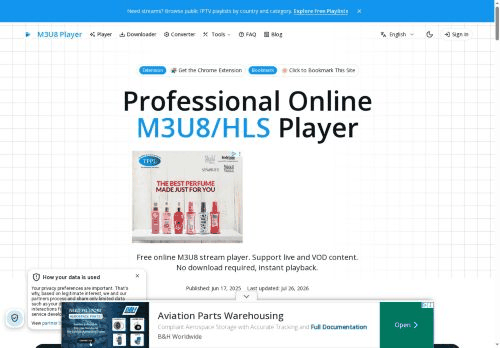
 StreamPulse: Next-Generation Client-Side HLS Media Suite and IPTV Intelligence Platform
Created 03 Oct 2026
StreamPulse represents the next evolutionary step in browser-native streaming media technology, building directly upon the foundational capabilities demonstrated by m3u8-player.net. Modern streaming architectures rely predominantly on HTTP Live Streaming (HLS) and M3U8 manifest declarations to deliver adaptive bitrate video across distributed consumer electronics. However, engineers, digital content publishers, media analysts, sports aggregators, and tech-savvy consumers frequently encounter fragmentation, severe cross-origin resource sharing (CORS) roadblocks, manifest syntax corruption, and privacy liabilities when testing, inspecting, converting, and orchestrating these distributed media feeds. StreamPulse addresses these systemic industry challenges through an all-in-one, privacy-first, web-native HLS workspace. Operating completely client-side via cutting-edge WebAssembly (Wasm) pipelines such as FFmpeg.wasm and browser-level multithreaded stream ingestion, StreamPulse eliminates external cloud compute liabilities, latency bottlenecks, and vendor-lock-in hosting costs. The platform combines instant manifest playback, real-time segment inspection, automated XMLTV/EPG matching, localized multi-threaded transport stream (TS) segment stitching, and regional IPTV curation workflows across global markets including Japan, Indonesia, France, Brazil, and the MENA region. By converting raw media playlists into clean, verified, and standards-compliant assets without transferring unencrypted video packets to remote intermediary servers, StreamPulse protects end-user privacy while drastically reducing corporate bandwidth infrastructure expenses. Additionally, StreamPulse introduces developer tooling such as lightweight embeddable responsive player widgets, adaptive bitrate stream stress-testing engines, and automated manifest sanitizers. With media organizations scaling over-the-top (OTT) delivery and distributed independent video operators requiring accessible validation tools, StreamPulse bridges the chasm between raw streaming infrastructure and effortless browser manipulation, unlocking high-efficiency video diagnostics, conversion, and global playlist management for international teams.
Industries
Get your First 100 Clicks in ONE MONTH
FREE with AI CMO (Saving £500+)
Save over £275 in ad value compared to paid traffic.Faster and Higher ROI than traditional SEO services (3–6 months) and lower cost (£500–£2000/month).
SEO Market Overview (Organic Search)
Global Video Streaming Technology and Developer Media UtilitiesOrganic search volume is anchored by high-intent developer utilities and media streaming terms. While consumer-facing queries such as video conversion and media playback feature elevated search volumes with lower conversion rates, B2B and broadcast engineer queries for stream diagnostics, playlist validation, and embeddable player SDKs command higher commercial value and CPCs.
9.7%
AI VisibilityGEO / AI Visibility Overview
How visible your brand is inside AI-generated answers
Unlock More Content Ideas
Create an account or log in to explore exclusive blog topics, SEO strategies, and GEO-targeted content generated by AI CMO Maggie
[ Tailored for your brand's next growth leap. ]
Maggie Studies the Tracks Before the Journey Begins.
She learns every detail of your business through deep market research.
Target Problem
The modern digital broadcasting ecosystem relies heavily on HTTP Live Streaming (HLS) protocols and dynamic M3U8 manifest structures. Despite being an ubiquitous industry standard, testing, diagnosing, and manipulating M3U8 streams remains fundamentally fragmented and technically cumbersome. Content engineers, broadcast technicians, sports media aggregates, and video quality assurance teams frequently struggle with opaque CORS restrictions, non-responsive streams, segment discontinuity errors, and manifest parsing failures. Traditional diagnostic workflows require clunky terminal utilities like command-line FFmpeg or heavy desktop media players like VLC, which lack quick web integration, manifest parsing inspection, and localized workflow isolation. Furthermore, existing online conversion and download portals present acute privacy and security risks. Most legacy converters ingest user-supplied media URLs into centralized third-party cloud servers where video frames are processed and re-encoded. This architecture compromises confidential corporate streams, introduces latency and queuing delays, violates user privacy, and incurs massive compute and bandwidth overhead for server operators. Simultaneously, the explosion of public and authorized IPTV channel directories has led to high link decay rates, broken playlists, missing electronic program guide (EPG) metadata, and zero standardized tooling to clean, organize, and validate channel health before consumption or redistribution. StreamPulse eliminates these persistent operational hurdles by deploying a sandboxed, zero-install, browser-based media terminal. By decentralizing stream fetching, manifest sanitization, segment concatenation, and format transcoding directly into the local browser sandbox via modern WebAssembly and web worker threading, StreamPulse removes cloud intermediary vulnerabilities, eliminates server bandwidth costs, and restores effortless, transparent stream playback and maintenance to global creators and developers.
Target Regions
Target Audience
Streaming Media Engineers & Video QA Developers
Broadcast engineers and web developers requiring rapid verification of HLS manifest syntax, adaptive bitrate ladder behavior, WebVTT subtitle tracks, and CORS compliance without spinning up local environments.
Broadcasters & Content Delivery Operators
Independent broadcasting entities, digital events producers, and CDN technical operators needing embeddable, low-overhead player widgets and stream testing tools across geo-distributed egress nodes.
IPTV Curators & Sports Stream Aggregators
Technologists and digital communities organizing public regional television feeds and sports fixtures who require automated stream health validation, EPG XMLTV mapping, and playlist cleanup.
Everyday Consumers & Tech Enthusiasts
End users wishing to view live M3U8 feeds or convert streaming video chunks into offline MP4 containers without installing complex desktop software, extensions, or sharing private data.
Market Research
The global video streaming software and web media processing market has experienced exponential expansion fueled by structural shifts in digital media consumption, remote broadcasting, and distributed video engineering. According to Grand View Research and Fortune Business Insights, the global video streaming market size was valued at approximately USD 89.03 billion in 2023 and is projected to expand at a compound annual growth rate (CAGR) of 21.5% from 2024 to 2030, reaching upwards of USD 330.8 billion. Concurrently, the video infrastructure and developer media tooling subsector accounts for a Total Addressable Market (TAM) exceeding USD 7.2 billion, driven by the proliferation of over-the-top (OTT) media services, enterprise webcasting, and decentralized IPTV infrastructure. Key drivers accelerating this domain include the universal deprecation of legacy RTMP in favor of HTTP Live Streaming (HLS) and Dynamic Adaptive Streaming over HTTP (DASH), the rising demand for low-latency live streaming, and the widespread adoption of browser standards like WebAssembly (Wasm), WebCodecs, and Web Workers. The Serviceable Addressable Market (SAM) for lightweight browser-based video utilities, playlist orchestrators, and diagnostic player SDKs encompasses over 12 million global web developers, independent broadcasters, media administrators, and enterprise QA specialists. Market dynamics indicate a rapid pivot toward edge and client-side processing to bypass skyrocketing cloud egress and compute tariffs levied by hyperscalers like AWS and Google Cloud. By migrating compute-intensive operations—such as multi-segment stream downloading, multiplexing, and format conversion—into the user client machine via WebAssembly, modern tools reduce processing costs by more than 90%. Competitive forces are delineated between legacy cloud-transcoding APIs (such as Cloudflare Stream, Bitmovin, and AWS Elemental) and fragmented desktop utilities (such as VLC, HandBrake, and command-line FFmpeg). StreamPulse bridges this split by capitalizing on the consumer demand for zero-install, cost-free, high-performance browser micro-tools that combine developer-grade diagnostic granularity with user-friendly consumer playback and playlist management.
The technological architecture of StreamPulse establishes a modern benchmark in client-side media engineering. Traditional web-based media conversion and stream diagnostics historically suffered from prohibitive infrastructure requirements: operating servers capable of ingesting multiple gigabits of raw transport stream data, re-encoding media chunks on CPU/GPU clusters, and paying symmetrical egress network tolls. StreamPulse sidesteps this economic bottleneck entirely by running FFmpeg compiled directly to WebAssembly (Wasm). Modern browser runtimes provide SharedArrayBuffer and multi-threaded Web Workers, allowing StreamPulse to spin up concurrent background tasks. These background threads query the M3U8 manifest, parse master ladders, initiate concurrent HTTP Range requests for .ts or fragmented .mp4 chunks, and pass raw binary data directly to the local WebAssembly memory space. As a result, demuxing, remuxing, subtitle extraction, and containerization occur within the user local RAM and CPU sandbox, achieving lossless MP4 container creation at speeds restricted only by the user local hardware and network throughput. The operational significance of this design cannot be overstated from an enterprise privacy and compliance standpoint. Modern organizations operating under strict regulatory regimes, including GDPR, CCPA, and HIPAA, face rigorous legal liabilities whenever confidential or unencrypted internal live streams pass through external servers. By executing all video downloading, segment stitching, and transcoding strictly in-browser without routing a single packet through an intermediary proxy, StreamPulse guarantees full end-to-end data confidentiality. Internal corporate broadcasts, proprietary video QA benchmarks, and geo-restricted educational video streams remain entirely within the client local browser instance, enabling security-sensitive organizations to deploy the tool internally without comprehensive third-party data processing agreements. Beyond basic playback and conversion, the platform revolutionizes the curation of open, authorized, and public IPTV channels. Global IPTV streams are prone to severe link rot, intermittent origin outages, changing token structures, and asynchronous audio-video drifts. StreamPulse solves this operational headache by deploying an intelligent playlist parsing engine. Users can import large M3U and M3U8 files comprising thousands of channel entries. StreamPulse automatically executes non-blocking HEAD/GET requests in the background, measuring round-trip latency, validating HTTP status codes, verifying manifest integrity, and identifying audio-only vs video-audio configurations. Channels are systematically tagged, filtered by operational health, categorized by geography, and cross-referenced with external XMLTV electronic program guide schemas via tvg-id tags, producing pristine, production-ready M3U playlists optimized for smart televisions and web players alike. From a monetization and growth perspective, StreamPulse implements a sustainable hybrid business model that respects developer preferences. The core web application remains completely free, zero-registration, and supported by lightweight, privacy-friendly contextual sponsorships and developer tool affiliate partnerships. Premium subscription tiers cater to enterprise media operations and high-volume IPTV curators, offering advanced features such as automated headless playlist monitoring, Slack and webhook alert integrations for broken master streams, high-concurrency client-side batch processing, custom branded white-label embed widgets, and dedicated CORS-proxy fallback nodes. By bridging consumer convenience with industrial-grade media analytics, StreamPulse is uniquely positioned to dominate the modern streaming utility ecosystem.
Maggie Maps Your Rivals Before Full Steam Ahead.
She benchmarks your brand against competitors to plot a smarter route.
Products & Services
Browser-Native HLS/M3U8 Player & Stream Inspector
A zero-latency, client-side streaming player supporting master and media playlists, multi-bitrate adaptive switching, low-latency HLS, WebVTT subtitle synchronization, and instant audio channel toggling without external plugins.
WebAssembly Stream Transcoder & MP4 Exporter
An in-browser media converter powered by FFmpeg.wasm that fetches remote TS/fMP4 video segments, demuxes streams, and packages them into MP4, WebM, or MKV containers entirely within the user browser runtime.
Resilient Multi-Threaded HLS Downloader
A high-performance manifest parser and segment fetcher featuring automated chunk retry mechanisms, multi-threaded pipeline fetching, local TS segment concatenation, and direct-to-disk filesystem export.
Global IPTV Hub & Playlist Sanitizer
An interactive playlist management dashboard facilitating automated dead-link pruning, EPG/XMLTV metadata synchronization, tvg-id mapping, and geo-specific categorization for open and authorized IPTV streams.
Embeddable Player SDK & Developer Diagnostics Suite
A customizable, lightweight embeddable iframe and JavaScript player kit accompanied by deep CORS inspection, manifest linting, network buffer visualizers, and stream health analytics.
Unique Selling Points
SWOT Analysis
Strength
Decentralized client-side execution through WebAssembly and FFmpeg.wasm, eliminating expensive backend transcoding servers and offering complete data privacy.
Weakness
Heavy dependency on browser memory limits, client-side CPU architecture, and web security models such as strict Cross-Origin Resource Sharing (CORS) policies on external servers.
Opportunity
Expanding appetite for privacy-respecting developer web tools, surging demand for IPTV playlist curation utilities, and increasing migration toward client-side edge computing.
Threat
Aggressive CORS enforcement and tokenized authentication on major content networks, alongside browser memory sandboxing constraints during high-definition, long-duration stream transcoding.
Market Competitors
M3U8 Player Online (m3u8-player.net)
Direct benchmark offering browser-native M3U8 playback, WebAssembly MP4 conversion, IPTV playlist curation tools, and multi-language support.
Visit Site Akamai HLS Player
Enterprise-grade reference testing player built on hls.js for validating stream health, multi-bitrate profiles, and delivery metrics across Akamai CDN.
Visit Site Bitmovin Stream Test Player
Commercial diagnostic tool tailored for enterprise OTT broadcasters validating HLS and MPEG-DASH streams with complex DRM and ad-insertion parameters.
Visit Site Hls.js Demo Player
Open-source developer demo player exposing granular buffer details, manifest metrics, segment timing statistics, and low-level diagnostic logs.
Visit Site IPTVnator
Popular open-source cross-platform IPTV player application supporting M3U and M3U8 playlists with integrated XMLTV EPG viewing capabilities.
Visit Site VideoJS HTTP Streaming Player
Standard open-source web player framework offering reference playback for HLS and DASH feeds across diverse browser environments.
Visit Site Online-Convert (Video Module)
Cloud-based file converter supporting video transformations, requiring file uploads to remote servers with associated bandwidth and privacy tradeoffs.
Visit Site AnyConv
Generic file conversion portal supporting M3U8 file processing through cloud queues with file size limitations and intrusive ad banners.
Visit Site OttPlayer
Cloud-managed IPTV service facilitating playlist aggregation, channel scheduling, and cross-device synchronization for television sets and smart boxes.
Visit Site JW Player Stream Tester
Developer utility for testing live and VOD HLS streams with integrated analytics, VAST ad testing, and adaptive bitrate tracking.
Visit SiteLaunch Effortless Blogging with Maggie
No more blank pages. Maggie runs your blog with vibe-rich, SEO-tuned, GEO-smart content — built to be loved by search engines and surfaced by AI.

Free Tools
AI Visibility CheckerAI Ideas BrainstormingAI Startup Trend AnalysisAI Project ManagementWordPress CheckerAI Co-Founders
Roadmap
All rights reserved by AI Marketing OS Ltd. Designed & Developed by TOPY.AI .