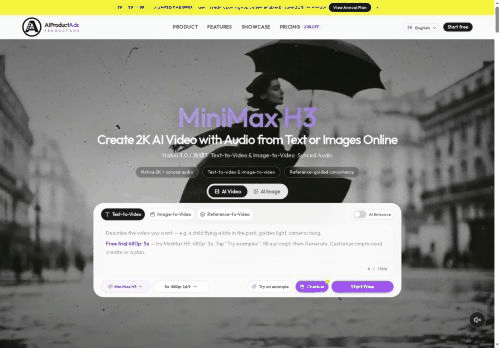
 MiniMax H3 Studio: Next-Generation Native 2K Multimodal AI Video & Commercial Ad Production Engine
Created 02 Oct 2026
MiniMax H3 Studio represents a generational leap in generative video technology, commercializing the advanced Hailuo 3.0 (海螺3) foundation model into an enterprise-grade video creation platform. Historically, generative AI video platforms have suffered from silent, disjointed outputs, short two-to-four-second temporal limits, severe physical hallucinations, and heavy resolution compression. MiniMax H3 dismantles these operational friction points by providing native 2K-class cinematic video generation with synchronized, context-aware audio generated in a unified single-pass inference workflow. Accessible through the minimaxh3.art software-as-a-service infrastructure, the platform natively bridges high-fidelity creative storytelling with high-converting performance marketing through its integrated AIProductAds suite. Users can transition seamlessly from natural language prompts to multi-ratio, 15-second cinematic cuts complete with expressive character dialogue, dynamic ambient acoustics, and crisp sound effects. The underlying multimodal conditioning architecture accommodates sophisticated reference-to-video pipelines, permitting users to input up to nine distinct image anchors, three video motion references, and three audio tracks. This guarantees character identity locking, precise wardrobe preservation, and rigid environmental consistency across successive takes. By consolidating prompt engineering, keyframe management, reference anchoring, credit-based computing, and rapid rendering into an all-in-one browser studio, MiniMax H3 enables creators, digital marketing agencies, and global e-commerce merchants to cut pre-production and post-production costs by up to eighty percent. Backed by scalable credit pricing tiers, multi-language internationalization, and an API-ready framework, the platform democratizes Hollywood-grade visual fidelity and automated merchandising video pipelines for the global digital economy.
Industries
Get your First 100 Clicks in ONE MONTH
FREE with AI CMO (Saving £500+)
Save over £915 in ad value compared to paid traffic.Faster and Higher ROI than traditional SEO services (3–6 months) and lower cost (£500–£2000/month).
SEO Market Overview (Organic Search)
Generative AI Video & Commercial Video ProductionIntense paid search competition fueled by venture-backed foundation model labs and B2B ad-tech platforms, driving elevated customer acquisition costs and demanding authoritative technical SEO.
0.0%
AI VisibilityGEO / AI Visibility Overview
How visible your brand is inside AI-generated answers
Unlock More Content Ideas
Create an account or log in to explore exclusive blog topics, SEO strategies, and GEO-targeted content generated by AI CMO Maggie
[ Tailored for your brand's next growth leap. ]
Maggie Studies the Tracks Before the Journey Begins.
She learns every detail of your business through deep market research.
Target Problem
The modern digital advertising and content production landscapes face an unsustainable operational bottleneck. High-performing digital video channels require an unrelenting volume of fresh creative assets, yet traditional live-action and studio-grade CGI production workflows remain cost-prohibitive, labor-intensive, and slow to scale. A high-converting 15-second video ad routinely costs thousands of dollars and weeks of turnaround time when factoring in casting, set logistics, shooting schedules, audio design, and post-production editing. While preliminary text-to-video AI tools introduced speed into the creative pipeline, they introduced severe operational deficiencies of their own. Early foundational video generators produced silent, low-resolution clips fraught with temporal morphing, frame-by-frame character drifting, and an inability to maintain consistent clothing or lighting. Creators were forced into a fragmented toolchain: rendering multiple four-second silent clips, running them through third-party video upscalers, attempting manual face-swapping for identity preservation, and contracting sound designers or hunting for royalty-free audio to manually score the footage. MiniMax H3 directly solves this systemic fragmentation. By fusing native 2K rendering, 15-second storytelling continuity, rigid reference-guided identity locking, and single-pass synchronized audio synthesis into a unified studio environment, MiniMax H3 enables non-technical creators and commercial enterprises to generate fully rendered, sonically rich video assets in minutes at a fraction of conventional costs.
Target Regions
Target Audience
E-Commerce Merchants & D2C Brands
Direct-to-consumer store operators and Amazon sellers requiring cost-effective, high-volume video ad variations from existing static product catalogs to reduce customer acquisition costs across paid channels.
Performance Marketing & Creative Agencies
Advertising agencies managing multi-brand social campaigns that need to rapidly prototype, A/B test, and scale localized commercial campaigns across 9:16 and 16:9 formats without booking studio production.
Independent Content Creators & Storytellers
Filmmakers, digital artists, and social media influencers who require cinematic motion cadence, audio-synchronized character dialogue, and identity continuity to produce narrative series and micro-dramas.
Game Developers & Entertainment Studios
Independent and mid-tier game development teams seeking to generate high-resolution concept cinematics, world-building teasers, and user acquisition game hooks quickly and economically.
Market Research
The global generative AI video market is experiencing exponential growth, transitioning from early exploratory novelties into mission-critical infrastructure for media, advertising, and e-commerce. According to market intelligence valuations from Bloomberg Intelligence and Grand View Research, the global generative AI market was valued at approximately USD 44.89 billion in 2023 and is projected to surpass USD 1.3 trillion by 2032, expanding at a compound annual growth rate (CAGR) exceeding 42%. Within this broader domain, the AI video generation market segment alone accounted for approximately USD 554 million in 2023 and is forecasted to exceed USD 2.56 billion by 2030, progressing at a CAGR of 32.5%. This growth curve is primarily propelled by the insatiable consumer demand for short-form video content across platforms such as TikTok, Instagram Reels, and YouTube Shorts, where short video formats generate over 2.5 times more user engagement than static imagery. The Total Addressable Market (TAM) for programmatic video marketing and automated digital content generation encompasses the global digital advertising industry, which reached USD 626.8 billion in 2023 and is moving toward USD 965 billion by 2028. The Serviceable Available Market (SAM) specifically targets digital production and creative asset development services, an addressable sector valued at roughly USD 68 billion. The Serviceable Obtainable Market (SOM) for MiniMax H3 focuses on e-commerce product video automation, creative agency ad prototyping, and indie studio cinematics, representing an immediate market potential of USD 4.8 billion across North America, Europe, and Asia-Pacific. Major growth drivers include declining commercial production budgets, the deprecation of third-party tracking cookies necessitating high-frequency ad creative refreshes, and the technical convergence of multimodal audio-visual foundation models. MiniMax H3's strategic advantage lies in targeting the latency and friction gap between static product imagery and finished, audio-synced video ads, capturing market share by solving the identity-drift problem that currently hampers enterprise adoption.
The commercialization of MiniMax H3 (Hailuo 3.0) represents a structural evolution in how visual media is authored, distributed, and monetized across modern internet platforms. By eliminating the divide between silent image generation and complex video post-production, the platform sets a new benchmark for multimodal generative infrastructure. The architectural foundation of MiniMax H3 relies on a unified spatio-temporal diffusion transformer capable of processing cross-modal conditioning tokens simultaneously. Instead of chaining an independent audio generation model onto a pre-rendered silent video clip, the H3 engine constructs acoustic dynamics—such as character vocal cadence, kinetic impacts, footsteps, and spatial reverb—in direct alignment with the physical kinematics unfolding on the visual screen. This unified latent space synthesis prevents the timing mismatch and uncanny-valley acoustics that typically plague AI video pipelines. From a practical commercial perspective, the platform's multi-reference capability unlocks enterprise use cases that were previously impossible. E-commerce brands operating across Shopify, Amazon, and TikTok Shop have struggled to maintain brand fidelity with first-generation generative video tools because models consistently distorted product packaging, altered typography, and altered physical geometries. MiniMax H3's reference-to-video subsystem enforces strict spatial preservation: an operator can upload an exact product render alongside a model photograph and an environmental backplate, prompting the engine to generate natural kinetic movement without drifting away from the actual product packaging. This fidelity is essential for compliance with consumer protection standards and platform advertising guidelines, transforming generative video from an experimental hobbyist toy into an enterprise merchandising asset. Furthermore, the platform's native support for varied aspect ratios (specifically 16:9 for cinematic desktop and television distribution, and 9:16 for vertical mobile consumption) addresses the operational realities of performance media buying. Modern creative teams run continuous A/B multivariate testing across social channels, requiring dozens of hook variations, pacing speeds, and background environments for a single campaign. Through the AIProductAds infrastructure, marketing teams can programmatically generate entire seasonal creative catalogs in minutes. This drastically reduces Customer Acquisition Cost (CAC) and accelerates the velocity of marketing experimentation, allowing digital brands to react instantaneously to trending social hooks and regional consumer demands. Technological scalability is sustained by an efficient credit-based computing framework that balances compute-heavy 2K generation with accessible entry tiers. By offering introductory credits alongside volume subscriptions, the platform lowers the friction of initial user adoption while establishing a dependable recurring revenue model. High-fidelity rendering queues are distributed across optimized GPU clusters, ensuring predictable generation turnaround times even during peak enterprise demand. Future platform expansions will incorporate native deep integration with enterprise product information management (PIM) databases, direct-to-ad-manager publishing webhooks, and advanced multi-character dialogue scripting. Ultimately, MiniMax H3 establishes a viable blueprint for the future of digital content synthesis. As foundation models continue to evolve, competitive differentiation will shift away from raw pixel synthesis toward controllable, consistent, and contextually rich workflows. By marrying native 2K visual resolution, character and object identity locking, cinematic temporal continuity, and contextually synchronized audio in an accessible SaaS ecosystem, MiniMax H3 positions itself as an essential infrastructure provider for the next era of digital marketing, virtual cinema, and creative digital media.
Maggie Maps Your Rivals Before Full Steam Ahead.
She benchmarks your brand against competitors to plot a smarter route.
Products & Services
MiniMax H3 Studio Web Platform
An interactive, browser-based creative suite supporting native 2K Text-to-Video and Image-to-Video synthesis with synchronized environmental audio, foley sound effects, and character vocalizations in 16:9 and 9:16 aspect ratios.
Multimodal Reference-to-Video Engine
A high-precision consistency framework that allows creators to lock character identities, facial features, apparel, and background environments using up to 9 reference stills, 3 motion clips, and 3 audio cues.
AIProductAds Automated Commercial Suite
A specialized commercial pipeline that converts static e-commerce catalog photos into dynamic, narrative-driven 5-second to 15-second video advertisements optimized for TikTok, Instagram Reels, and YouTube Shorts.
Enterprise High-Throughput Batch API
Programmatic generation endpoints designed for creative agencies, gaming studios, and merchandising platforms requiring programmatic scale, priority queue computing, and custom watermark embedding.
Unique Selling Points
SWOT Analysis
Strength
End-to-end multimodal synthesis offering native 2K clarity and integrated audio pairing, eliminating post-production stitching and delivering immediate commercial utility.
Weakness
Significant GPU compute intensity per 2K 15-second render, requiring robust cluster orchestration to manage generation queues and maintain acceptable user latency.
Opportunity
Rapid market expansion into programmatic automated advertising via API integrations with Shopify, Meta Ads Manager, and TikTok for Business ecosystems.
Threat
Intense competitive pressure from well-capitalized foundation model providers such as OpenAI (Sora), Runway, Kuaishou (Kling), and Luma AI.
Market Competitors
 Runway (Gen-3 Alpha)
Pioneering creative video suite offering advanced camera controls and multi-asset keyframing, primarily focused on Hollywood-grade cinematic toolsets but requiring third-party audio integration.
Visit Site Kling AI (Kuaishou)
High-motion simulation AI video generator excelling at realistic physical movement and longer clip lengths, widely popular among social creators.
Visit Site Luma Dream Machine
High-speed realistic video generation model designed to synthesize high-motion camera shots and smooth physics simulations with low latency.
Visit Site OpenAI Sora
State-of-the-art visual diffusion model capable of generating up to one-minute cinematic scenes with complex camera dynamics and physical environmental modeling.
Visit Site Pika Labs (Pika 2.0)
Creator-centric AI platform specializing in social video effects, frame-level modifications, and integrated sound effect generation.
Visit Site Haiper AI
Visual foundation model platform offering user-friendly text-to-video, image repainting, and intuitive video generation for commercial and independent makers.
Visit Site Midjourney Video
Upcoming and expanding visual generation ecosystem known for exceptional aesthetic control and artistic textures transitioning into animated media.
Visit Site Vidu AI
High-speed Chinese foundation video model providing rapid multi-second dynamic video creation with strong physical coherence and character stability.
Visit Site PixVerse
Consumer and creator platform offering multi-ratio 4K AI video generation, style transfers, and intuitive motion brushes.
Visit Site Stable Video Diffusion (Stability AI)
Open-weights foundation video model serving as a base architecture for enterprise customization and self-hosted visual inference workflows.
Visit SiteLaunch Effortless Blogging with Maggie
No more blank pages. Maggie runs your blog with vibe-rich, SEO-tuned, GEO-smart content — built to be loved by search engines and surfaced by AI.

Free Tools
AI Visibility CheckerAI Ideas BrainstormingAI Startup Trend AnalysisAI Project ManagementWordPress CheckerAI Co-Founders
Roadmap
All rights reserved by AI Marketing OS Ltd. Designed & Developed by TOPY.AI .